

Are Parallel Lines No Solution
Systems of Linear Equations: Graphing
When you are solving systems of equations (linear or otherwise), yous are, in terms of the equations' related graphed lines, finding whatever intersection points of those lines.
If a organisation of equations consists but of a pair of 2-variable linear equations, and so this arrangement's equation can be graphed; the graph volition incorporate two straight lines, and the solution to the system will exist the intersection bespeak(southward) of those lines. Considering two straight lines in the plane can graph in only three types of means, in that location are then just three corresponding forms of solution for a given system of equations.
Two direct lines (i) accept different slopes and intersepts, and then they cross at exactly i point, (2) are parallel with different intercepts, so they never intersect at any points, or (iii) they take the aforementioned slope and intersepts, so they're actually the same line, so they "intersect" everywhere (where "everywhere" ways "everywhere the ane line goes, so goes the other line; they have all their points — infinitely-many points — in mutual"). These three cases for pairs of straight lines are illustrated beneath:
The first graph above, beingness "Case 1" in the left-hand column, shows two distinct non-parallel lines that cross at exactly one point. The respective system of equations is called an "contained" system, and the solution is a unmarried ( x,y )-point.
The second graph above, being "Case 2" in the middle column, shows two distinct lines that are parallel. Since parallel lines never cross, then in that location can exist no intersection of these lines; that is, for a system of 2 linear equations that graphs equally two parallel lines, at that place can be no solution. This is called an "inconsistent" arrangement of equations.
The third graph higher up, being "Case 3" in the right-paw column, appears to evidence just one line. Really, it'due south the same line drawn twice. These "two" lines, really being the aforementioned one line, "intersect" (in a technical sense) at every betoken forth their lengths. This means that every point on the line(s) is a solution to the arrangement. This is called a "dependent" organization, and the "solution" is the whole line.
This shows that a organisation of equations may take one solution (a specific ten,y -betoken), no solution at all, or an infinite solution (beingness all the solutions to the equation). You will never have a two-linear-equation, two-variable organisation with ii or more solutions; it volition always be one, none, or infinitely-many.
If it'southward a dependent organization, why isn't "space" or "all points" a valid reply?
While the solution to a dependent system of linear equations is an space set of points, "infinty" is non a number, "infinite" isn't sufficiently clear, and points off the system's line(s) are not solutions. Simply those points that are actually on the line are solutions to the system. So your answer for organisation blazon would be "dependent", merely the solution would actually exist the line'south equation, as this equation implicitly lists all the points that solve the organisation.
For instance, if the two equations in a dependent system reduced downwardly to y = −10 + iii, then you lot should state the solution as being that line equation, or you could use coordinate-pair notation; namely, (x, −x + 3).
Solving past Graphing
Probably the starting time method you'll see for solving systems of equations will be "solving by graphing". Alert: You accept to have these issues with a grain of salt. The only way you can find the solution from the graph is IF you describe a very bully axis system, IF you draw very smashing lines, IF the solution happens to be a point with nice neat whole-number coordinates, and IF the lines are non close to existence parallel.
For instance, if the lines cross at a shallow angle it tin be just nearly impossible to tell where the lines cross.
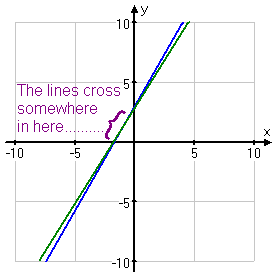
And if the intersection point isn't a neat pair of whole numbers, all bets are off. I mean, tin can you tell, only past looking...
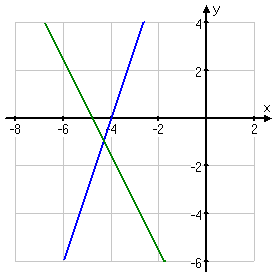
...that the displayed intersection in a higher place has coordinates of (−4.iii, −0.95)? No? Then you see my betoken.
On the plus side, since they volition be forced to requite you prissy slap-up solutions for "solving by graphing" issues, you will exist able to get the right answers as long equally you graph very neatly. For instance:
-
Solve the post-obit system by graphing.
2x − 3y = −two
4ten + y = 24
I know I need a neat graph, so I'll take hold of my ruler and get started. Kickoff, I'll solve each equation for " y=", so I tin can graph easily:
210 − 3y = −2
2x + 2 = iiiy
(2/3)x + (2/3) = y
four10 + y = 24
y = −fourten + 24
The 2nd line will be piece of cake to graph using just the gradient and intercept, but I'll demand a T-nautical chart for the first line.
Sometimes you'll notice the intersection right on the T-nautical chart. Do y'all see the point that is in both equations above? Bank check the gray-shaded row higher up.
At present that I have some points, I'll take hold of my ruler and graph neatly, and look for the intersection:
Fifty-fifty if I hadn't noticed the intersection signal in the T-chart, I can certainly come across it from the picture.
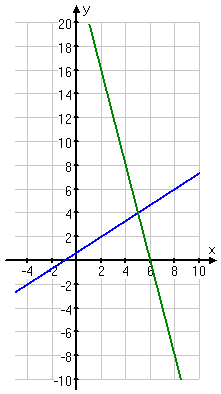
solution: (ten, y) = (5, four)
When you're stuck doing "solving by graphing", please, for heaven'south sake, describe the lines then they actually cross at the solution point. Don't be sloppy!

Are Parallel Lines No Solution,
Source: https://www.purplemath.com/modules/systlin2.htm
Posted by: sotouldwes.blogspot.com
0 Response to "Are Parallel Lines No Solution"
Post a Comment