

All Sonnets Have Fourteen Lines
You've probably heard of the Shakespearean sonnet, or perchance even the Petrarchan sonnet. Simply those are just two types of sonnets. In that location are actually many other forms! As new poets have tinkered with more traditional approaches to the sonnet over time, they've come up with their own approaches to writing sonnets, too. In this article, we're going to help you learn most all of the major types of sonnets by: Are you gear up? Let'southward cheque out some sonnets! Earlier we get into the types of sonnets, we desire to briefly talk about the elements most sonnets have in mutual. (Check out this article for an proficient guide to the sonnet grade.) A sonnet is a type of poem that traditionally has 14 lines that are written in iambic pentameter. The formal and structural elements of sonnets became standardized equally the sonnet became popular. But over time, new poets establish their own ways to write sonnets. In other words, every bit poets have experimented with the form and structure of the sonnet, those new approaches to writing sonnets have created new "types" of sonnets, like the early Italian and the English sonnet. Thematically, you lot tin typically sniff out a traditional sonnet if it deals with one main thing: love. Still, like with the grade and structure of sonnets themselves, the themes portrayed in sonnets accept also expanded to include topics like politics, nature, organized religion and spirituality, and social bug. While there are differences between the types of sonnets that have been adult over time, they can be pretty tough to option out if analyzing sonnets is a new thing for yous. To help you place each blazon of sonnet all on your own, we're going to hash out every major sonnet type you need to know. One quick note: while our listing is comprehensive, it definitely doesn't contain every type of sonnet known to man! We're just trying to cover the types of sonnets you lot're most likely to read. To acquire nearly the obscure sonnet types that didn't make the cut, bank check out the Poesy Foundation. Nosotros'll start with the Italian or Petrarchan sonnet considering it was the commencement blazon of sonnet to become pop! The Petrarchan sonnet was popularized by the Italian poet Francesco Petrarch in the 1300s, which is why it'south interchangeably called an Italian sonnet or Petrarchan sonnet. Y'all'll be condom using either name to refer to this type of poem. Petrarchan sonnets take 14 lines—divided into an octave and a sestet—that follow the rhyme scheme ABBA ABBA CDCCDC or ABBA ABBA CDECDE. (Non certain what rhyme scheme is? We'll talk most information technology more afterwards, or you can bank check out this in-depth guide.) Petrarchan poems are divided into two sections so the poet tin can enquire questions and accomplish an reply. Thematically, the octave , or offset 8 lines, often makes a suggestion, which asks a question or describes a problem. Then the sestet , or final half dozen lines, proposes a resolution or solution. It's mutual for the transition from the description of the question/problem to the resolution to happen around the ninth line in Petrarchan sonnets. This shift from problem to resolution is chosen the "turn," or volta . So you tin can retrieve of a Petrarchan sonnet as a fancy Q&A session or a mini-argument! Finally, Italian sonnets are almost e'er written in iambic pentameter. (We'll talk more virtually iambic pentameter later!). Just at present, let's take a look at a Petrarchan sonnet. Where long the shadows of the wind had rolled, Then in a land where all days are non fair, Despite being written in the twentieth century, Robinson uses a Petrarchan form and construction in "The Sheaves." In this sonnet, Robinson ponders the significance and beauty of a field of wheat. The imagery Robinson uses in this sonnet creates a romantic feeling: the field of wheat is compared to gold and is described as lending a "vast magic" that'south unexplainable. In fact, the beauty of the world, embodied by the aureate field, is even more precious than real golden! Robinson makes employ of a traditional Petrarchan ABBAABBA CDCDCD rhyme scheme. (The matching letters represent similar rhymes.) As is characteristic of Petrarchan sonnets, Robinson structures his sonnet into an octave and a sestet, and makes use of a volta to initiate a turn or shift in the tone of the poem at the beginning of line ix. At the volta, Robinson admits that, though the wheat field makes the whole world seem beautiful, "all days are not off-white"—a realistic observation compared to the dreamy romanticism of the octave. Robinson knows that the wheat field's beauty is limited, which nosotros realize when the wheat gets cut and bound into sheaves. Robinson's poem is a expert example of a Petrarchan sonnet because it employs the pattern of making a proposition at the starting time in the octave—that all the world is beautiful, as exemplified by the wheat field—and providing a resolution to that suggestion in the sestet—that, similar the youth of a thousand girls with golden hair, the beauty of the world changes over fourth dimension. "Romeo and Juliet" by Ford Madox Brownish (1869-1870) Like the Italian/Petrarchan sonnet, the English sonnet has multiple names every bit well. The English sonnet is often called a Shakespearean sonnet since the poet William Shakespeare was the most prolific (and famous!) English sonnet-writer during the sixteenth century. You might even hear this blazon of poem called an Elizabethan sonnet, since Queen Elizabeth I loved them! English sonnets have 14 lines of poesy, but this type of sonnet has three quatrains and one couplet instead of an octave and a sestet. Also, these sonnets follow an ABAB CDCD EFEF GG rhyme scheme. A single quatrain is made upwardly of four lines of poetry, and a couplet is made up of two lines. Like Petrarchan sonnets, English sonnets are unremarkably in a Q&A format. But the different structure and rhyme scheme affects how English language sonnets communicate their themes. In an English language sonnet, the volta happens right before the couplet instead of in the middle of the poem. This means that the three quatrains requite the poet more space to ask their question and build tension, just the unmarried couplet at the finish gives the poet simply ii lines to find an answer. This construction makes the poem more than dramatic, and it oft means the poet's "answer" is more cryptic! Two households, both alike in nobility, The Prologue to Shakespeare's play, Romeo and Juliet, is actually an example of an English sonnet. Shakespeare uses a sonnet to show that romantic dearest and tragic conflict are going to be two main themes of the play. This creative choice shows just how common information technology was for people to associate sonnets with themes of love and tragedy during the Elizabethan Era. Offset, you can tell this is a sonnet considering it uses the archetype structure of three quatrains and a terminal couplet with the rhyme scheme ABAB CDCD EFEF GG. More than importantly, this sonnet sets the stage for the disharmonize that plays out in the play, telling a tale of 2 well-respected, Italian families who have bad blood between them. For instance, in the 2nd quatrain, the speaker in the verse form tells the audience that the disharmonize between the two families worsens when their children fall in love and, ultimately, decide to take their ain lives. The sonnet concludes with a couplet—some other central feature of the English sonnet. The couplet here makes a shift from the first twelve lines past speaking directly to the play's audience, encouraging them to listen patiently and pay attention to the story that the Prologue introduced. In other words, it answers the unsaid question nigh what happens next. (Answer: just watch!) Shakespeare'south approach to the sonnet embodies all the characteristics that the English sonnet is known for today: the structure, rhyme scheme, presentation of a theme and a trouble in the three quatrains, and the use of a volta at the couplet to explicate how the problem will be resolved. Well-nigh of all, The Prologue to Romeo and Juliet embraces the major theme of English language sonnets: dear. An engraving of the poet Edmund Spenser Spenserian sonnets are slightly dissimilar and less common than other forms. Spenserian sonnets are named after the English poet who popularized them, Edmund Spenser. These sonnets use the same structure as English sonnets (three quatrains and a couplet), but rely on a more complicated rhyme scheme: ABAB BCBC CDCD EE. So in club to tell Shakespearean and Spencerian sonnets apart, you have to wait closely at the rhyming pattern. What makes the rhyme scheme of a Spenserian sonnet more than complicated is that it repeats the same stop rhyme several times over. Trying to think of more repeated rhymes that fit naturally into the sonnet can be more difficult for the poet! Furthermore, Spenser uses each quatrain to develop a metaphor, question, thought, or conflict in a logical manner. At the stop of his sonnets, he uses the couplet to brand a bold statement that resolves the themes presented in the quatrains. Spenser as well often included an early volta around line 9 of his sonnets, but the first volta in his sonnets is a scarlet herring—the truthful resolution doesn't come up until the couplet at the finish! Sweet is the rose, only grows upon a briar; It'due south pretty easy to tell that this is a Spenserian sonnet...since it was written past the poet Edmund Spenser! At first glance, this Spenserian sonnet might seem like an English sonnet, only this poem uses the more complicated rhyme scheme that Spenserian sonnets are known for: ABAB BCBC CDCD EE. By paying shut attention to the rhyme scheme, you can tell that this is a Spenserian sonnet that ponders the ideas of love and pleasure. In this sonnet, Spenser makes use of repetition to reinforce both a theme and a problem in the three quatrains. By repeating the same phrase over and over ("Sweet is the...") and using the aforementioned sentence structure in each line, Spenser makes it clear that "every sweet with sour is tempered however." In other words, the adept and the bad often get together. To reinforce this idea, the showtime two quatrains name several things that are sweet, like roses and the broom-bloom, then point out that these sweetness things all grow on sharp, prickly, or sour trees and bushes. In the third quatrain, Spenser explains why it's significant that the sweetest things are often accompanied by things that cause pain: because people like a challenge! Spencer says that people don't really value things they tin get easily. Things that are difficult to become prove more satisfying in the end. Because of the false volta at the beginning of line 9, signaled past Spenser's use of the word "and then," it may seem like the problem of sweet only prickly things is resolved in the tertiary quatrain. But there's still the couplet to come, and that's where the problem is ultimately resolved. Spenser concludes that considering good things and bad things often go together, nosotros shouldn't worry nigh enduring a fiddling pain when the sweet matter will reward united states of america with pleasure. That reward, Spenser claims, more than makes up for the problem. Portrait of John Milton circa 1629 You're probably catching onto the fact that most types of sonnets are named after the poets who popularized them, and the Miltonic Sonnet is no exception. Named after the English poet John Milton, Miltonic sonnets use the same rhyme scheme (ABBAABBA CDECDE) and structure (an octave and a sestet) of a Petrarchan sonnet. Miltonic sonnets bargain with different themes than the other types of sonnets, though. Instead of tackling questions of romantic love or nature, Miltonic sonnets often deal with politics and moral issues thematically, and they utilise something called enjambment to tighten the sonnet's structure. If yous're worried about telling Miltonic sonnets apart from Petrarchan sonnets, don't! Just take a look at the author. If y'all find a sonnet written past Milton, then you know it's this specific class. (Yes, sometimes it's that simple!) HOW soon hath Time, the subtle thief of youth, We know this is a Miltonic sonnet because it was written by John Milton, only it as well demonstrates Milton's deviation from the archetype love theme of early on sonnets. Instead, this sonnet considers the experience of growing older and what the passing of time means for Milton's delivery to serving God throughout his life. One thing that Milton's sonnets practise have in mutual with English or Petrarchan sonnets thematically is that they tend to focus on the meaning of a single event. The difference is the events in Milton's sonnets are usually more political, intellectual, or spiritual in nature. That's certainly the case in this sonnet: Milton is writing virtually his twenty-third altogether, which leads him to ponder his future. Like in Italian sonnets and English sonnets, Milton presents a problem at the very beginning of the octave. His twenty-third year has gone by way too fast! He's entering "manhood" now, just he doesn't have much to show for it. But then the volta happens at the get-go of the sestet. Milton realizes that despite how he feels about what he's accomplished and then far in life, what matters almost is that the passing of time leads him to do the volition of "his great Task-master," which is God. See how Milton'southward sonnets tend to exist a little bit more than serious in tone than the honey sonnets we looked at before? That's a central way that you can tell a Miltonic sonnet from other types of sonnets. The sonnet has remained a popular poetic grade. Many contemporary poets continue to write sonnets, though modern sonnets don't attach to one specific form or theme. In fact, modernistic sonnets have fifty-fifty been chosen a "ghost imprint" of traditional sonnets. Sometimes modern sonnets rely on the traditional fourteen lines; sometimes they don't. They also toy effectually with rhyme schemes and are more free with the types of themes they choose to employ in their version of the sonnet. But, commonly, you lot can spot a modern sonnet considering it will follow near (but not all!) of the rules nosotros've outlined higher up. To get a better feeling for a modernistic sonnet, we'll break down Adam Kirsch'south "Professional person Centre-class Couple, 1927," a contemporary poem that shows you what to look for when reading modern sonnets. What justifies the inequality Kirsch'southward mod sonnet is written in Petrarchan form—sort of. Information technology begins with an octave that pretty much follows the ABBAABBA cease rhyme scheme, but instead of catastrophe with a sestet that follows the CDCCDC or CDECDE end rhyme scheme, it ends with another octave that follows ABBAABBA. This is a small change that tweaks the sonnet class to make it fresh and new. In fact, Kirsch's sonnet is an instance of another uncommon sonnet blazon: the stretched sonnet , which refers to sonnets that extend to 16 or more lines. Kirsch'southward sonnet besides puts a modern spin on the age-quondam theme of romantic love. The title of the sonnet refers to a "professional middle-class couple." People normally assume that a "couple" is 2 people who are in love. But this poem goes in a different direction. Kirsch describes what the husband and married woman are wearing in the first octave, simply these descriptions are not complimentary. For every particular that Kirsch mentions near the couple'south appearance—a ring with a giant gemstone, a wrinkled accommodate—he addresses the unjust labor weather condition that made them possible. So, but like in traditional sonnets, Kirsch starts with a proposition: the idea that the middle class couple's displays of prosperity come at the expense of others. You might notice that this sonnet is made up of two sentences, and that the offset sentence ends and the second judgement begins smack-dab in the middle of the sonnet, halfway through line 9. This seems to be Kirsch'due south unique take on the volta, which is another small-scale tweak to the classic sonnet form. After the volta at the outset of the second octave, Kirsch describes the but thing that could redeem the centre class couple: acknowledging the ways that their pursuit of prosperity has hurt and degraded others, and irresolute how they use their prosperity in the hereafter. When yous know what to look for, modernistic sonnets aren't as tricky to spot! A sketch of Percy Bysshe Shelley by Amelia Curran Terza Rima is an Italian term for a poetic verse form that uses an interlaced, or chain, rhyme pattern of ABA BCB CDC DED. Terza Rima translates to "tertiary rhyme" in English, and each private stanza of a terza rima is often called a tercet since it consists of iii lines of poesy. The fourteenth century Italian poet Dante made the get-go known apply of terza rima in his famous epic poem, the Divine Comedy . Later on, the Italian poet Petrach—the Petrarchan sonnet's namesake—made use of the terza rima form besides. The terza rima form can exist repeated over and over—there isn't a set number of lines for a terza rima, which makes it different from a traditional sonnet! However, when a terza rima ends, information technology concludes with either a single line or a couplet that repeats the rhyme of the middle line of the concluding tercet. Hither's an instance: if the rhyme scheme of the final tercet of a terza rima is DED, then the rhyme of the final line will be E, or the rhyme of the concluding couplet volition exist EE. A terza rima doesn't accept a set up rhythm, only poets writing in English will often use iambic pentameter. The terza rima course is meliorate suited to writing in Italian since there are fewer rhyming words in English language than Italian! Still, famous poets like Geoffrey Chaucer, Percy Bysshe Shelley, and Robert Frost have made successful utilise of the terza rima in English over the years. In fact, Percy Bysshe Shelley'due south poem, "Ode to the West Wind," is a good example of the terza rima! O wild West Wind, thousand jiff of Autumn'south beingness, Yellowish, and black, and pale, and hectic red, The winged seeds, where they lie cold and depression, Her clarion o'er the dreaming earth, and fill Wild Spirit, which fine art moving everywhere; Shelley's "Ode to the Due west Current of air" is a long poem, and then nosotros've simply included the first section here. Only, that's okay, because the commencement section of Shelley's poem provides a full example of a terza rima! This sonnet follows the ABA BCB CDC DED EE rhyme scheme that the terza rima is known for. If you lot read the residuum of the poem, you'll also see that the full poem is made upwards of a series of five terza rima sonnets. So what is "Ode to the West Wind" about? Well, the championship gives a pretty good inkling that Shelley is praising the power of the wind! In this first terza rima of the poem, for example, Shelley marvels at how the west current of air has the power to control other things in nature during the dissimilar seasons of the yr. The due west current of air has the power to blow away expressionless leaves in autumn, and blow blooms off of trees during spring. In both the beginning line and next-to-last line of this section, Shelley refers to the due west wind as "wild." In fact, in the last couplet, he calls the west wind a "Wild Spirit." He makes the west air current sound kind of like a supernatural being or even a god—it has the power to destroy and preserve. This first terza rima is setting upwards the residue of Shelley'due south ode, which explores how Shelley wishes the power of the west wind would change him, but like information technology changes nature. The curtal sonnet was invented by the Victorian poet Gerard Manley Hopkins. The simple way to explain a curtal sonnet is that it's a shortened version of the traditional fourteen line sonnet, shrunk proportionally. Hopkins was really interested in the mathematical proportions of sonnets, then we'll have to do some math to explicate the formulaic way that Hopkins condensed the traditional sonnet into the curtal sonnet. A curtal sonnet is fabricated upwardly of eleven lines total, which is three-quarters the length of a traditional sonnet. Petrarchan sonnets are made up of an octave and a sestet, right? And then a curtal sonnet shrinks the octave to three-quarters of its length, shortening it from eight lines to six lines. And then, a curtal sonnet shrinks the sestet to three-quarters of its length, shortening it from six lines to four lines. And so a curtal sonnet is actually made upward of a sestet and a quatrain. To go to that important eleventh line, curtal sonnets include a "tail piece" at the very stop. The tail piece just refers to the eleventh and final line of the sonnet, which is usually much shorter than the other lines in the verse form. Since the length of a curtal sonnet is totally different from a traditional xiv line sonnet, the rhyme scheme is pretty unlike too. A curtal sonnet follows either an ABCABC DBCDC or ABCABC DCBDC rhyme scheme. Very few poets accept made use of Hopkins' curtal sonnet, and Hopkins himself only used the curtal sonnet in iii of his poems: "Pied Dazzler," "Peace," and "Ash Boughs." We'll take a look at "Pied Beauty" as an example of a curtal sonnet side by side! Celebrity be to God for dappled things – All things counter, original, spare, strange; The first stanza of this English sonnet consists of six lines, making it a sestet, the 2nd stanza consists of iv lines, making it a quatrain. It also has a tail piece at the very terminate, comprising the eleventh line! The rhyme scheme also fits a curtail sonnet. The beginning sestet follows an ABCABC rhyme scheme, and the catastrophe quatrain and tail slice follow a DBCDC rhyme scheme. Now, let'south talk nearly the English sonnet'southward themes. We tin can tell from the very beginning line that this is a religious verse form—Hopkins is praising God for the creation of the beautiful things in nature. He references several things that are beautiful in very different ways, like the sky, the pattern of a trout's scales, and that has been farmed. Hopkins is praising God for being a creator of things that exhibit beauty in vastly dissimilar ways in the first nine lines of this curtal sonnet. Only then the volta, or a turn, happens in the tenth line. For the entire poem, he's been praising the unpredictability and multifariousness exhibited in God's creations, but he pivots to praising God'due south unchangeability in the tenth line: "He fathers-forth whose beauty is past modify." Just this alter in theme is meant to praise God even more than. By describing God every bit unchangeable and constant, Hopkins emphasizes how God is set apart from nature. In some cases, poets will write several sonnets that connect with each other through a unified subject or theme. These are called sonnet serial or sonnet sequences. In that location are three principal types: the sonnet sequence, the crown of sonnets, and the sonnet redouble. A sonnet sequence is a drove of sonnets that address the same field of study matter, which oft involves a dramatic situation or person. Information technology can be made up of Spencerian, Shakespearean, Petrarchan, or Miltonic sonnets. So a verse form similar Shakespeare's "Sonnet 128" can be an example of both a Shakespearean sonnet and a poem in a sonnet sequence about music (in conjunction with "Sonnet eight"). The "crown of sonnets," besides chosen the "sonnet corona," is comprised of fifteen sonnets and uses a repeated formal constraint to express the aforementioned theme in each poem. Here's how a sonnet corona achieves thematic continuity: the last line of the very starting time sonnet acts as the commencement line of the next sonnet in the sequence, and the last sonnet'south terminal line repeats the first line of the first sonnet in the sequence...making a giant loop! At that place'southward some other type of sonnet sequence, as well. This one is called the "heroic crown" or "sonnet redouble," which is an advanced class of the sonnet corona. A heroic crown is also fabricated up of xv sonnets that are linked in the same way equally sonnet coronas, but the terminal sonnet in the sequence is fabricated upwards of all of the beginning lines of the previous fourteen sonnets—in order! The fifteenth sonnet in a heroic crown is called a "master sonnet." Sounds pretty complicated, huh? We'll give you one example of a sonnet sequence here: a crown of sonnet called A Wreath For Emmett Till, found in a children's volume by Marilyn Hacker. Three Pierced by the screams of a shortened babyhood, Four Emmett Till's name yet catches in my pharynx, We didn't want to copy an entire sonnet corona for y'all to read through here (fifteen sonnets is a lot!), but we did want to include a few successive sonnets from a single sequence and so yous can see it in action. These three sonnets from Marilyn Hacker's children'southward book, A Wreath for Emmett Till, loosely employ a Petrarchan end rhyme scheme: ABBAABBA CDECDE. Y'all can also run into how sonnets "IV" and "5" make use of the corona by repeating the last line of the previous sonnet in their first line. Here's an instance: Concluding line of sonnet "III": "Emmett Till'south name still catches in the pharynx." Start line of sonnet "4": "Emmett Till'due south proper noun still catches in my throat." See? At that place'southward a very small variation in the diction, but otherwise the line stays the same. This repetition enables the poet to create an overarching theme across the multiple sonnets in the sequence. Ultimately, the last line/beginning line repetition allows the poet to tell an extended story. In the case of Hacker'due south children'due south book, the story being told is an extremely important ane. A Wreath for Emmett Till tells a truthful story nigh a young African-American boy who was lynched for a offense he did not commit in 1955. Hacker makes the harrowing story of Emmett Till accessible to young readers by relying on some of the traditional thematic elements of sonnets: providing a vivid, detailed clarification of the chief character'southward concrete appearance and the environs that surrounds them. Poetry can exist actually intimidating, merely the best way to learn how to read information technology is to exercise. In this article, i of our experts walks y'all through analyzing Dylan Thomas' "Practice non go gentle into that adept night." By the terminate of the post, you'll be analyzing poetry like a pro! We've talked almost nine of the poetic devices yous should know to clarify sonnets, but there are many more than that tin be useful tools as you analyze a poem. Learn more most the 20 poetic devices you should know, and accept a deep swoop into some of the most important ones (like personification and imagery). If you're trying to brush upward on sonnets to ready for the AP English Literature exam, don't worry. We have tons of resources for you! Start by reviewing our good's guide to the exam, then bank check out our complete list of practice tests and books y'all should readfor the essay portion. Need more assist with this topic? Check out Tutorbase! Our vetted tutor database includes a range of experienced educators who tin help you lot polish an essay for English or explain how derivatives work for Calculus. You can use dozens of filters and search criteria to find the perfect person for your needs. 
A Brief Introduction to the Sonnet
What Is a Sonnet?
Sonnet Form and Theme
What Are the Differences Between Sonnet Forms?

Italian or Petrarchan Sonnets
An Italian Sonnet/Petrarchan Sonnet Example: "The Sheaves" by Edwin Arlington Robinson
Light-green wheat was yielding to the change assigned;
And as by some vast magic undivined
The globe was turning slowly into gold.
Like nil that was ever bought or sold
It waited there, the body and the heed;
And with a mighty pregnant of a kind
That tells the more the more it is not told.
Fair days went on till on another twenty-four hour period
A thousand golden sheaves were lying there,
Shining and nonetheless, but non for long to stay –
As if a chiliad girls with golden hair
Might rise from where they slept and get away.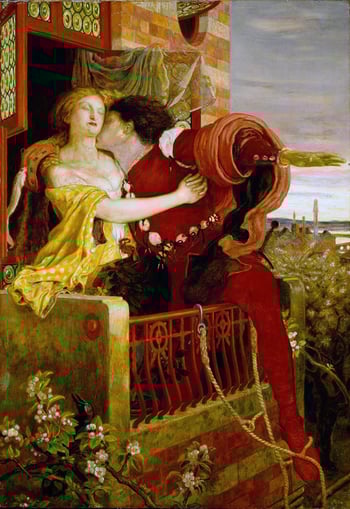
English or Shakespearean Sonnets
An English Sonnet Example: "Prologue," From Romeo and Juliet by William Shakespeare
In fair Verona, where we lay our scene,
From ancient grudge break to new mutiny,
Where ceremonious blood makes civil hands unclean.
From along the fatal loins of these 2 foes
A pair of star-cantankerous'd lovers accept their life;
Whose misadventured piteous overthrows
Do with their decease bury their parents' strife.
The fearful passage of their death-marking'd love,
And the continuance of their parents' rage,
Which, only their children's end, nought could remove,
Is at present the ii hours' traffic of our phase;
The which if you with patient ears attend,
What hither shall miss, our toil shall strive to mend.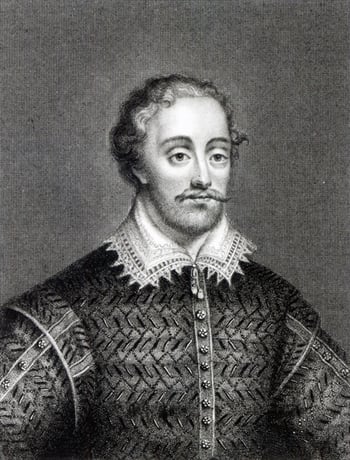
Spenserian Sonnets
A Spenserian Sonnet: XXVI from Amoretti by Edmund Spenser
Sugariness in the Juniper, just abrupt his bough;
Sweet is the Eglantine, but pricketh near;
Sweet is the firbloom, simply his branches crude.
Sweetness is the Cypress, just his rind is tough,
Sweetness is the nut, merely biting is his pill;
Sugariness is the broom-flower, but yet sour enough;
And sweet is Moly, but his root is ill.
Then every sweet with sour is tempered however
That maketh information technology exist coveted the more than:
For piece of cake things that may be got at will,
Near sorts of men exercise prepare but petty store.
Why so should I business relationship of little pain,
That endless pleasure shall unto me gain.
Miltonic Sonnet
A Miltonic Sonnet: "Number vii: On His Beingness Arrived to the Historic period of Twenty-3" by John Milton
Stolen on his wing my three and twentieth twelvemonth!
My hasting days fly on with full career,
Just my late bound no bud or blossom shew'th.
Perhaps my semblance might deceive the truth,
That I to manhood am arrived so nearly,
And inward ripeness doth much less appear,
That some more timely-happy spirits indu'thursday.
All the same be it less or more, or soon or slow,
It shall be withal in strictest mensurate even
To that same lot, however mean or high,
Toward which Time leads me, and the will of Heaven,
All is, if I have grace to use information technology then,
Equally always in my great Task-chief'due south eye.
Modern Sonnets
A Modern Sonnet: "Professional Heart-Class Couple, 1927," past Adam Kirsch
That issues her a tastefully square-cut
Ruby for her finger, him a adapt
Whose rumpled, unemphatic dignity
Declares a life of working sitting down,
While someone in a sweatshop has to squint
And palsy sewing, and a continent
Sheds blood to pry the gemstone from the ground,
Could not be justice. Null just the use
To which they put prosperity can speak
In their defence force: the faces coin makes,
They demonstrate, don't have to be birdbrained,
Entitled, vapid, arrogantly strong;
Only amid the burghers practise you discover
A glance so frank, engaging, and refined,
So tentative, and so witting of its wrong.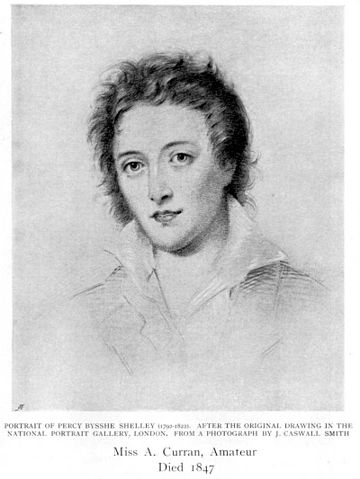
Terza Rima Sonnet
A Terza Rima Sonnet: " Ode to the West Wind ," by Percy Bysshe Shelley
Thou, from whose unseen presence the leaves dead
Are driven, like ghosts from an enchanter fleeing,
Pestilence-stricken multitudes: O thou,
Who chariotest to their dark wintery bed
Each like a corpse within its grave, until
Thine azure sister of the Spring shall accident
Driving sweet buds like flocks to feed in air
With living hues and odours plain and hill:
Destroyer and preserver; hear, oh, hear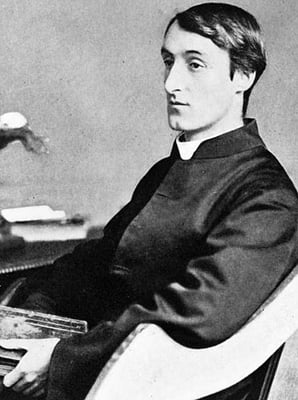
Photo of a young Gerard Manley Hopkins. Curtal Sonnet
A Curtal Sonnet: " Pied Beauty ," past Gerard Manley Hopkins
For skies of couple-color as a brinded cow;
For rose-moles all in stipple upon trout that swim;
Fresh-firecoal anecdote-falls; finches' wings;
Mural plotted and pieced – fold, fallow, and plough;
And áll trádes, their gear and tackle and trim.
Whatsoever is fickle, freckled (who knows how?)
With swift, slow; sweet, sour; adazzle, dim;
He fathers-forth whose dazzler is past alter:
Praise him.
Sonnet Sequences
A Crown of Sonnets: A Wreath for Emmett Till , by Marilyn Hacker
my heartwood has been scarred for fifty years
by what I heard, with hundreds of green ears.
That jackal laughter. Two hundred years I stood
listening to small struggles to find food,
to the songs of creature life, which disappears
and comes once more, to the music of the spheres.
Two hundred years of deaths I understood.
Then slaughter axed i placidity summer night,
shivering the deep silence of the stars.
A running male child, five men in close pursuit.
One dark, v pale faces in the moonlight.
Racket, silence, back-slaps. Ane friction match, five cigars.
Emmett Till's name still catches in the throat.
like syllables waylaid in a stutterer'southward mouth.
A fourteen-year-old stutterer, in the South
to visit relatives and to be taught
the family's means. His mother had finally bought
that White Sox cap; she'd made him swear an adjuration
to be careful around white folks. She's told him the truth
of many a Mississippi anecdote:
Some white folks have blind souls. In his suitcase
she'd packed dungarees, T-shirts, underwear,
and comic books. She'd given him a note
for the conductor, waved to his chubby face,
wondered if he'd call back to castor his hair.
Her simply child. A body left to bloat. What'southward Next?


Ashley Sufflé Robinson has a Ph.D. in 19th Century English Literature. As a content writer for PrepScholar, Ashley is passionate virtually giving college-bound students the in-depth information they need to go into the school of their dreams.

All Sonnets Have Fourteen Lines,
Source: https://blog.prepscholar.com/types-of-sonnets
Posted by: sotouldwes.blogspot.com
0 Response to "All Sonnets Have Fourteen Lines"
Post a Comment