

How Tall Does A Moose Get
| Alaska moose | |
|---|---|
 | |
| Conservation status | |
| | |
Scientific classification  | |
| Kingdom: | Animalia |
| Phylum: | Chordata |
| Course: | Mammalia |
| Order: | Artiodactyla |
| Family: | Cervidae |
| Subfamily: | Capreolinae |
| Genus: | Alces |
| Species: | A. alces |
| Subspecies: | A. a. gigas |
| Trinomial name | |
| Alces alces gigas Miller, 1899 | |
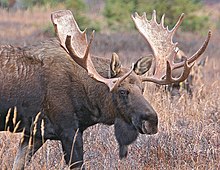
The Alaska moose ( Alces alces gigas ), or Alaskan moose in Alaska, or giant moose and Yukon moose in Canada, is a subspecies of moose that ranges from Alaska to western Yukon. The Alaska moose is the largest subspecies of moose.[1] Alaska moose inhabit boreal forests and mixed deciduous forests throughout near of Alaska and well-nigh of Western Yukon. Like all moose subspecies, the Alaska moose is usually solitary but sometimes volition form small herds. Typically, they only come up into contact with other moose for mating or competition for mates. The males and females select dissimilar foraging habitats leading to spatial segregation throughout much of the year.[2] During mating flavour, in autumn and winter, male Alaska moose get very ambitious and prone to attacking when startled.
Diet [edit]

A young bull browsing on alder twigs in winter
Alaska moose have a like diet to other moose subspecies, consisting of terrestrial vegetation forbs and shoots from trees such as willow and birch. Alaska moose require a daily intake of 9770 kilocalories (32 kg). Alaska moose lack upper front teeth simply have eight sharp incisors on their lower jaw. They also take a tough tongue, gums and lips to help chew woody vegetation.[1] [3]
Size and weight [edit]
Alaska moose are sexually dimorphic with males being 40% heavier than females.[4] Male Alaska moose tin stand over 2.1 m (6.ix ft) at the shoulder, and counterbalance over 635 kg (one,400 lb). When Alaska moose are built-in, they weigh on average about 28 pounds, but by v months former they can weigh up to 280 pounds.[3] The antlers on average have a span of one.viii thou (5.9 ft). Antler size and conformation are influenced past genetics, nutrition, and historic period. The antlers establish social rank and affect mating success.[5] Female Alaska moose stand on average 1.eight m (5.9 ft) at the shoulder and tin weigh close to 478 kg (one,054 lb).[one] The largest Alaska moose was shot in western Yukon in September 1897; it weighed 820 kg (one,808 lb), and was two.33 m (7.6 ft) tall at the shoulder.[6] While Alaska moose with the Chukotka moose, matches the extinct Irish elk, they are smaller than Cervalces latifrons, the largest deer of all time.[7]
Habitat [edit]
Alaska moose are almost omnipresent in Alaska. They range from Southeast Alaska to the Arctic slope in Northern Alaska, and are most likely to be found in the Northern forests. They are more densely concentrated along the major rivers in Alaska, such as the Stikine or Yukon river. They tin as well be found near areas that accept recently experienced wildfires, since that country generates dumbo willow, birch, and aspen shrubs. Many moose move during mating and calving seasons, and for winter. This can take them up to 60 miles away from their normal habitats.[8]
Social structure and reproduction [edit]

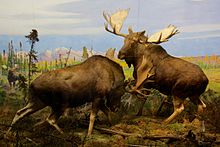
Alaska moose have no social bonds with each other and only come into contact with each other to mate, or for ii bull moose to fight over mating rights. Although a balderdash moose is not commonly aggressive towards humans, during mating flavor it may assail whatever creature it comes into contact with, including humans, wolves, other deer or fifty-fifty bears. Balderdash moose can get their antlers locked during a fight, and if then both moose can die from severe injuries or starvation. However, unlike deer, "fighting bull moose rarely lock horns as their antlers are palmated."[9] [10] Bull moose call out a subtle mating call to attract female moose and to warn other males. If a male moose loses to another male person, he has to await another yr to mate. Alaska moose mate every year during autumn and winter, and usually produce one or two offspring at a time. At around ten–11 months, yearling Alaska moose leave their mothers and fend for themselves.[iii]
Hunting [edit]
Alaska moose are hunted for nutrient and sport every yr during autumn and winter. People use both firearms and bows to hunt moose.[8] It is estimated that at least 7,000 moose are harvested annually, generally by residents who eat the moose meat.[viii] They are besides hunted past animal predators: wolves, black bears, and brown bears all hunt moose.[viii]
References [edit]
- ^ a b c Long, Nancy; Savikko, Kurt (August 7, 2009). "Moose: Wildlife Notebook Series – Alaska Department of Fish and Game". Adfg.country.ak.us. Archived from the original on November xxx, 2009. Retrieved Nov 27, 2009.
- ^ Oehlers, Susan A.; Bowyer, R. Terry; Huettmann, Falk; Person, David G.; Kessler, Winifred B. (2011). "Sex and scale: implications for habitat pick by Alaskan mooseAlces alces gigas". Wildlife Biology. 17 (1): 67–84. doi:10.2981/10-039. ISSN 0909-6396. S2CID 86133235.
- ^ a b c "Moose Species Profile, Alaska Department of Fish and Game". Adfg.alaska.gov . Retrieved 2022-02-11 .
- ^ Bord, Daniel De. "Alces alces (Eurasian elk)". Animaldiversity.org . Retrieved 2020-04-12 .
- ^ Schmidt, Jennifer I.; Hoef, Jay M. Ver; Bowyer, R. Terry (2007). "Antler Size of Alaskan Moose Alces Alces Gigas: Effects of Population Density, Hunter Harvest and Use of Guides". Wildlife Biology. thirteen (1): 53–65. doi:10.2981/0909-6396(2007)thirteen[53:ASOAMA]2.0.CO;2. ISSN 0909-6396. S2CID 54672842.
- ^ Woods, The Guinness Book of Creature Facts and Feats. Sterling Pub Co Inc (1983), ISBN 978-0-85112-235-9
- ^ "Cervalces latifrons". Prehistoric-fauna.com . Retrieved 2022-02-sixteen .
- ^ a b c d "Moose Hunting Data, Alaska Department of Fish and Game". Adfg.alaska.gov . Retrieved 2022-02-16 .
- ^ "Archived copy" (PDF). Archived from the original (PDF) on 2020-eleven-03. Retrieved 2020-10-31 .
{{cite web}}: CS1 maint: archived copy as title (link) - ^ "Bull moose battle to the expiry | GazOutdoors Blog". Billingsgazette.com.
Further reading [edit]
- Van Ballenberghe, Victor (Baronial 1987). "Giants of the Wilderness: Alaskan Moose". National Geographic. Vol. 172, no. two. pp. 260–280. ISSN 0027-9358. OCLC 643483454.

How Tall Does A Moose Get,
Source: https://en.wikipedia.org/wiki/Alaska_moose
Posted by: sotouldwes.blogspot.com
0 Response to "How Tall Does A Moose Get"
Post a Comment